
Each year we survey public attitudes to charities, something we first began over 20 years ago. More recently this has been accompanied by our survey of trustees (the people responsible for managing charities) to understand what they think about the role.
With the findings of this year’s public and trustee research fresh off the press, we sat down with Neal from our Strategic Policy Team, to discuss the purpose behind our research programme, how it’s evolved and the most significant learnings from his time overseeing its delivery.
Why measure public trust in charities?
Our statutory objectives (meaning what the law says we’re there to do as a regulator) start with increasing public trust and confidence in charities.
We don’t license or inspect charities; we’re there to assure people that charities are well-regulated. So, when you give to charity, whichever the cause, you can do so with trust and confidence.
The public trust research, therefore, is one way in which we can measure our impact. We also want to use the findings to positively inform the public and political debate about charities, and to highlight to charities where they can do better.
The Commission also surveys charity trustees, why is that?
Most of our regulation is done through giving advice, guidance and permissions to help charities improve and get it right. We also make sure they keep their register details up to date and file accounts on time, only intervening directly in the small number of cases where something goes really wrong. So, the trustee survey is another means for us to measure our effectiveness.
It helps us to understand, do charities use our guidance? Do trustees understand their responsibilities? And what can we do better to support them?
For example, findings that there are certain areas in which trustees are more confident than competent have informed how we promote engagement with our guidance.
What’s the biggest lesson you’ve learnt from the research?
A very small change to a question can completely change the answer! For example, we used to ask: In the last year have you donated money or goods, or raised funds for a charity?
Last year 48% of people said yes.
But this year we wanted to split those things out to measure them individually. What then happened was:
This year 48% said they had donated money, 50% said they had donated goods, and 15% said they had raised funds, with 70% of people having done any one of those things.
We don’t think that really represents a sudden huge increase in giving but it’s possible that splitting out the question made people realise they had done more.
So, it’s really important that we get the questions right, as is the integrity and consistency of the research. Because we want to use it as evidence – evidence we can use as a regulator, and that the sector can use as well.
So, the research has evolved over the years?
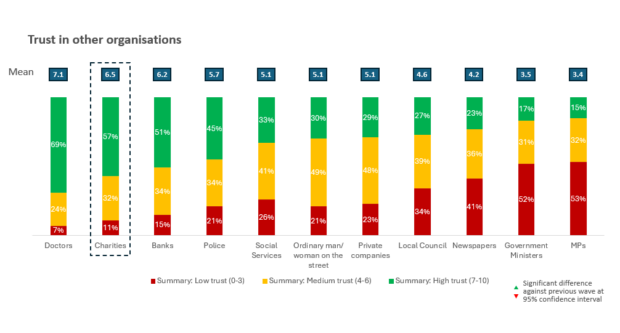
Yes, it’s evolved as our understanding has grown. For example, we began by asking the public “how much do you trust charities on a scale of 0-10?” But this can feel a bit abstract and difficult to answer.
So now we also ask: “how much do you trust charities compared to other professions, such as doctors or MPs?”, as well as further questions to drill into what matters to people when it comes to their trust in charities and if their expectations are being met.
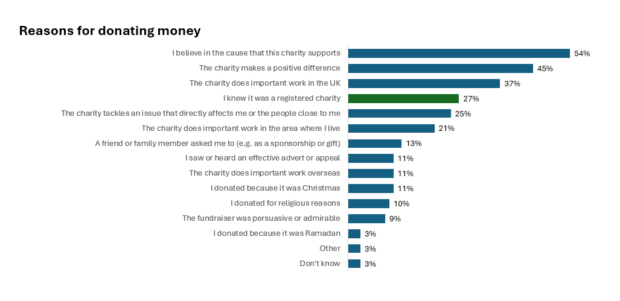
We also regularly include new themes to enhance our understanding of the public and charities. For example, this year we investigated why people choose to support particular charities – with most respondents saying the main reason is because the charity’s cause resonates with them, followed by being able to see the difference it makes.
What are the most significant trends you’ve seen over time?
We have been measuring people’s contact with charities since 2020 (just before the Covid pandemic). Since then, there has been a sharp upward trend in people getting help from charities, reflecting the many economic shocks we’ve had during that period. We know at the same time charities have struggled financially, also facing increased costs of their own, coupled with a decline in giving. This year the curve for people receiving support from charities has levelled off and dipped again – which, although we don’t know for sure, hopefully represents some easing of the strain.
However, we should also talk about what hasn’t changed!
What hasn’t changed then?
Since 2020 the public’s overall trust in charities has remained high and very stable – and we consistently see that information on how money is spent by a charity is the most important factor in driving public trust.
It’s great that the public can see the collective difference made by charities across the country, and our research provides vital insights into how that trust can be helped maintained.
Going forward, we’ll continue to ask the questions that matter; shaping our research to delve into the issues that will help inform our services and understanding of any future challenges the sector may face.
Discover insights from our 2026 public research and trustee research findings.
Recent Comments