
Small charities are the lifeblood of civil society: deeply embedded in their communities, trusted by those they serve, and often the first to respond when needs arise.
While big charities grab the headlines nationally, it might surprise people to know that most registered charities are small and are the fabric of the sector.
A sector dominated by small organisations
Our latest Annual Return 2024 analysis underlines just how central small charities are to the charity landscape.
Annual returns are the information we ask charities to provide, so we can understand how they’re doing individually and as a whole. We ask for less detail from smaller charities, and more from the biggest.
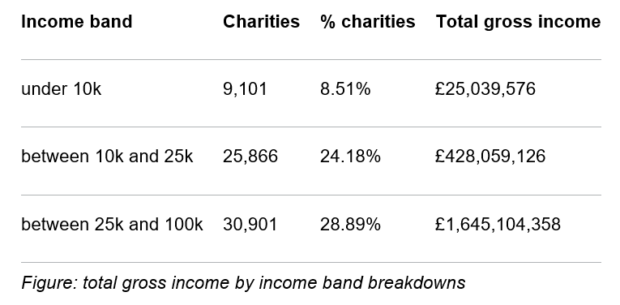
Some 65,868 charities said they had an income of less than £100,000 in 2024. Breaking this down further, around one in three charities (32%) reported an income of less than £25,000, rising to three in five charities (61%) by including those reporting an income of less than £100,000.
Achieving impact
Small charities play a unique and irreplaceable role. They reach communities that larger organisations often cannot. They are agile, responsive and rooted in lived experience. They build trust and social cohesion at a local level. In many cases, they are delivering services to people who might otherwise fall through the gaps.
This wide-ranging contribution to our communities includes everything from keeping green spaces and village halls open, to running foodbanks and community cafes, to offering youth clubs and riding lessons for disabled children – even providing beekeeping advice. The breadth is extraordinary.
These examples are all of very small charities with incomes of less than £15,000. While each charity may have a small income and expenditure, between them small charities expended some £2.3 billion delivering impact.
And none of it would be possible without the support and generosity of the public. The smallest charities, those with income under £10,000, get more than half of their income from donations and legacies.
Small charities are making good on public donations, delivering impact, all while showing incredible resilience.
The 2024 analysis shows a challenging reality for small charities with many operating on the narrowest margins. This leaves little room for unexpected costs or fluctuations in income, making every financial or in-kind donation and volunteering hour even more important.
For many small charities, people are their greatest asset, giving time when it might not be possible to give money.
Looking ahead
Small charities are not just a feature of the sector—they are its foundation.
It also means continuing to shine a light on their contribution—because understanding the reality for small charities is essential to supporting them effectively.
The Annual Return 2024 analysis shows a sector that has huge impact, but some small charities are facing pressures, often with the least resource and the greatest uncertainty. Their resilience, innovation and commitment remain extraordinary. But they cannot be taken for granted.
The 2024 data points to a clear priority: strengthening the resilience of small charities. That means:
- supporting trustees to make informed financial decisions
- encouraging sustainable funding approaches
- recognising the importance of volunteers and community support
- ensuring regulation remains proportionate and enabling
As a regulator, we will continue to use our data and insight to better understand the challenges they face—and to ensure that small charities across England and Wales can continue to thrive.
You can look up small charities in your area on our public Register of Charities or find other ways to support them during and beyond this year’s Small Charity Week.
2 comments
Comment by Mike Clarke posted on
I'm a trustee of two small charities. Having just spent a slightly irritated two minutes reading this bromide, I do wonder if the CC has any idea what to do to support small charities when they're under threat from multiple angles. It may be unfair to judge on the strength of one puff piece, but nothing would appear to be the answer....
Comment by Chasityrit posted on
Hey there, this marks my very first experience posting on this forum. I’ve been browsing many the threads and I’m genuinely impressed by how much helpful and well explained content people share. It’s refreshing to see a place where members truly take the time to break things down in a clear way. I’m still figuring out how everything is set up, but so far this seems like a reliable place to get information. I have lately been reading about this lately.